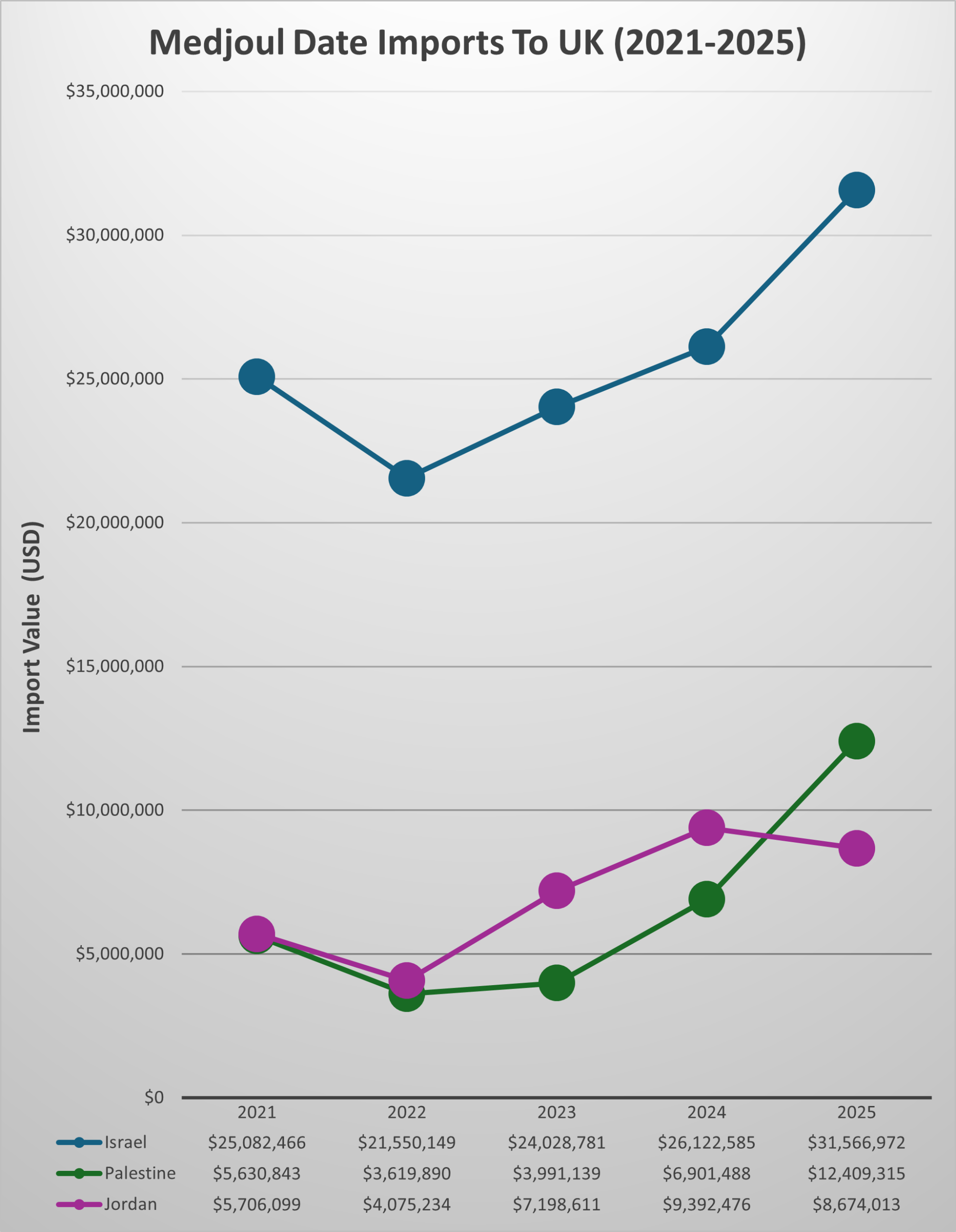
After Israel, the largest exporters of Medjoul dates to the UK are Jordan and Palestine.
Jordanian farmers do not face the same constraints as Palestinian farmers living under a brutal military occupation, which allows Jordanian dates to reach international markets freely while Palestinian producers are systematically restricted.
As a result, Jordan has consistently held a larger share of the UK market over the past five years, with the exception of 2025 when 1,790 tons of Palestinian dates were exported to the UK compared to 1,573 tons from Jordan.
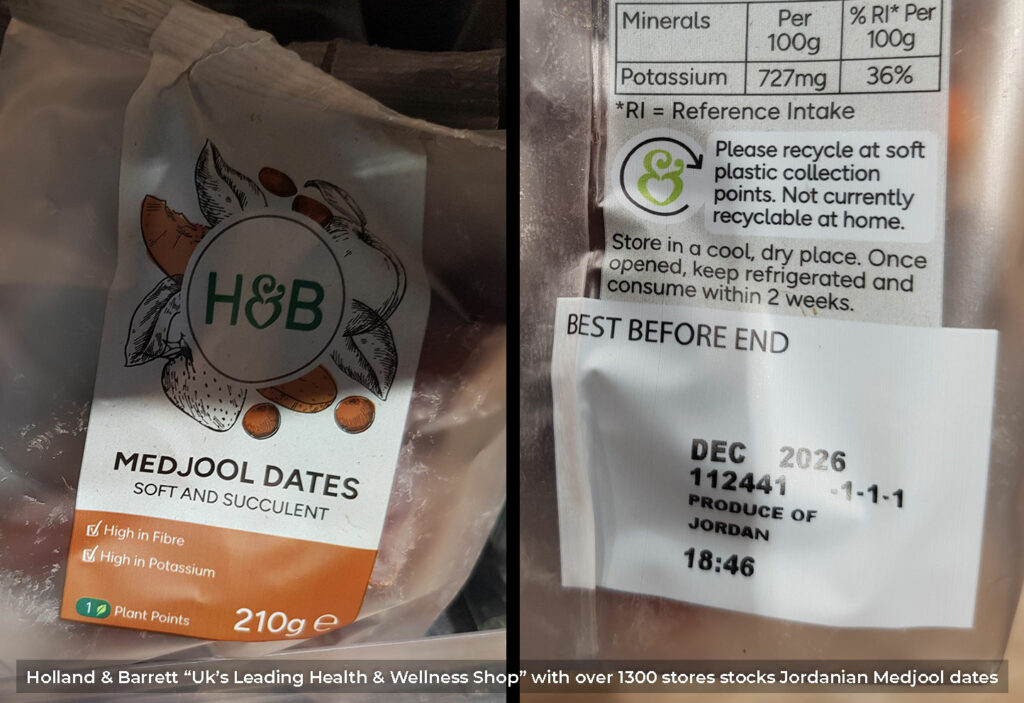
Jordanian Medjoul dates are often marketed as an ethical alternative for consumers seeking to avoid Israeli products. However, this framing obscures a deeper reality: Jordan’s date industry – and wider economy – is sustained in significant part by resources taken from Palestinians, alongside growing political and military alignment with Israel.
Built on Stolen Palestinian Resources
Since the 1994 Wadi Araba normalization agreement, Jordan’s economy has become deeply intertwined with Israel in ways that rely on access to Palestinian land, water, and natural resources under occupation.
This dependency is not abstract – it directly underpins key sectors including agriculture, energy, and trade, and is reinforced through political and military cooperation.
Stolen Palestinian Water
Jordan’s access to water is heavily dependent on stolen Palestinian supplies controlled by Israel.
Under bilateral agreements, Jordan receives water from Lake Tiberias – water denied to Palestinians. What began as 50 million cubic metres annually increased to 100 million, with a 2022 memorandum proposing a further 200 million cubic metres per year, covering around 30% of Jordan’s total water needs.
Compare this to the meagre 28.6 million cubic metres water allocation the Palestinians gained in return for signing the Oslo II Interim Agreement in 1995. 23.6 million cubic metres of which is for the West Bank, with Israel only committed to bearing the cost of 4.5 million cubic metres (Oslo II, Sept 1995, Annex 3 Article 40)
Half of Jordan’s water is used in agriculture, including irrigation for Medjoul date farming, where each tree requires up to 100 cubic metres annually. In effect, a water-intensive export industry is sustained while Palestinian farmers face severe water shortages and restrictions on accessing their own natural resources.
Although the latest expansion of this agreement was paused following public backlash due to the genocide in Gaza, it remains a clear example of how Jordan’s agricultural output is linked to water extracted under occupation.
Stolen Palestinian Natural Gas
This dependency extends beyond water.
In 2016, Jordan signed a $10 billion deal to import natural gas from Israel – gas extracted from fields off the coast of Gaza, from which Palestinians receive no benefit.
Today, well over 50% of Jordan’s energy needs are met through this supply of stolen Palestinian natural gas.
In 2024, Israel’s Energy Minister Eli Cohen when announcing that gas exports to Jordan and Egypt from the Leviathan and Tamar fields rose by 25%, described these exports as “a strategic asset for Israel” used to maintain “regional stability” – in practice, a tool of leverage over neighbouring states.
Political and Military Alignment
Economic dependence has translated into political and military alignment.
During Israel’s attack on Iran, Jordan shielded Israel by intercepting Iranian missiles and drones over its airspace, even though it resulted in falling debris injuring people in Jordan, who, unlike Israelis, lack access to shelters. More recently, Jordan has allowed its territory to be used to launch direct attacks on Iranian civilian infrastructure in operations aligned with Israeli strategic interests.
This demonstrates how reliance on Israeli-controlled – and Palestinian-derived – resources is not neutral; it is tied to active regional alignment.
QIZ Zones
The normalisation agreement also created Qualified Industrial Zones (QIZs) in Jordan, embedding Israeli economic interests directly into Jordan’s export industries.
Within these zones, Israeli companies – such as textile giant Delta Galil, whose clients include Walmart, Smart, Gloria Vanderbilt, Victoria’s Secret, Limited Brands, JC Penney, GAP, Kohl’s, and Target – partnered with Jordanian factories that provided low-cost labour, replacing Palestinian workers whose permits had been revoked during the Second Intifada.
The 13 QIZ zones encompass hundreds of factories employing about 48,000 workers, of whom at least 25,000 are foreign guest workers – predominantly women from Bangladesh.
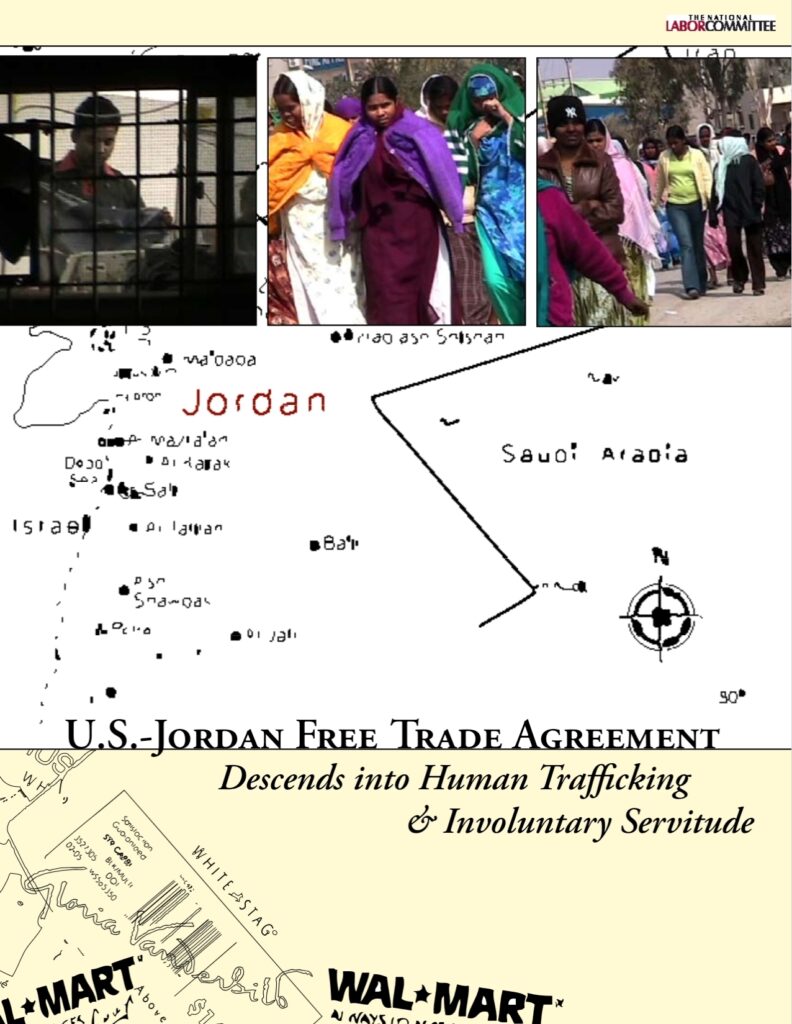
A 2006 report by the U.S.-based National Labor Committee, “U.S. Jordan Free Trade Agreement Descends into Human Trafficking,” described conditions in these factories as among the worst of any sweatshop. Workers reportedly had their passports confiscated, endured 16–20 hour shifts seven days a week for roughly two cents per hour, and lived in dormitories as small as 12 feet squared shared by 28 workers with water available only every third day. Reports also included beating, torture, and sexual abuse of women; one 20-year-old Bangladeshi woman committed suicide after being raped by her manager.
Israel was outsourcing sweatshop production to Jordan.
In return, these jointly produced goods – effectively Israeli in origin – were granted duty-free access to U.S. markets while being labelled as Jordanian.
As a result, Jordanian exports to the United States in 2005 surged to more than 80 times their 1998 level, totalling well over a billion dollars in apparel alone.
This pattern demonstrates how Israeli-linked production became embedded in regional supply chains, allowing origin to be obscured while economic benefits flow to Israel through Jordan.
Risk of Israeli Date Re-routing
Similar concerns now arise in the date sector.
In 2023, amid circulating rumours, the Jordanian Dates Association denied that Jordan imports dates from Israel, emphasising that the country is self-sufficient in date production. The Ministry of Agriculture has also maintained that the import of Medjoul dates is prohibited under national product protection policies. However, United Nations data shows that Israel exported approximately $540,000 worth of dates to Jordan in 2024. Given that in the same year Jordan exported $9.4 million worth of dates to the United Kingdom – its second-largest market – this is not an insignificant figure.
This discrepancy raises legitimate questions whether some of these dates are subsequently re-exported under a Jordanian label, whether Israeli dates could be entering international markets indirectly, potentially bypassing consumer boycotts through such re-export channels.
Marketing That Leverages Palestine
In the UK, Jordanian Medjoul dates are frequently marketed to ethically conscious consumers using references to Palestine – despite not being Palestinian products.
This creates a disconnect between branding and reality, particularly when the underlying production system is linked to resources denied to Palestinians.
The Dates Project
The Dates Project sells a product called “Dates for Palestine”, presented in packaging featuring the Dome of the Rock and strong humanitarian messaging. The branding strongly suggests a direct connection to Palestine, which many consumers will reasonably interpret as meaning the dates themselves are Palestinian.
However, “Dates for Palestine” is not the same as “Dates from Palestine”. This distinction is fundamental, yet it is not made clear at the point of purchase.
The company states:
“100% of the profits contribute to charity, making it an exceptionally meaningful and thoughtful gesture. Each purchase of the Dates for Palestine tin ensures that water is provided for 100 families in Gaza, adding a significant humanitarian dimension to this special gift.”
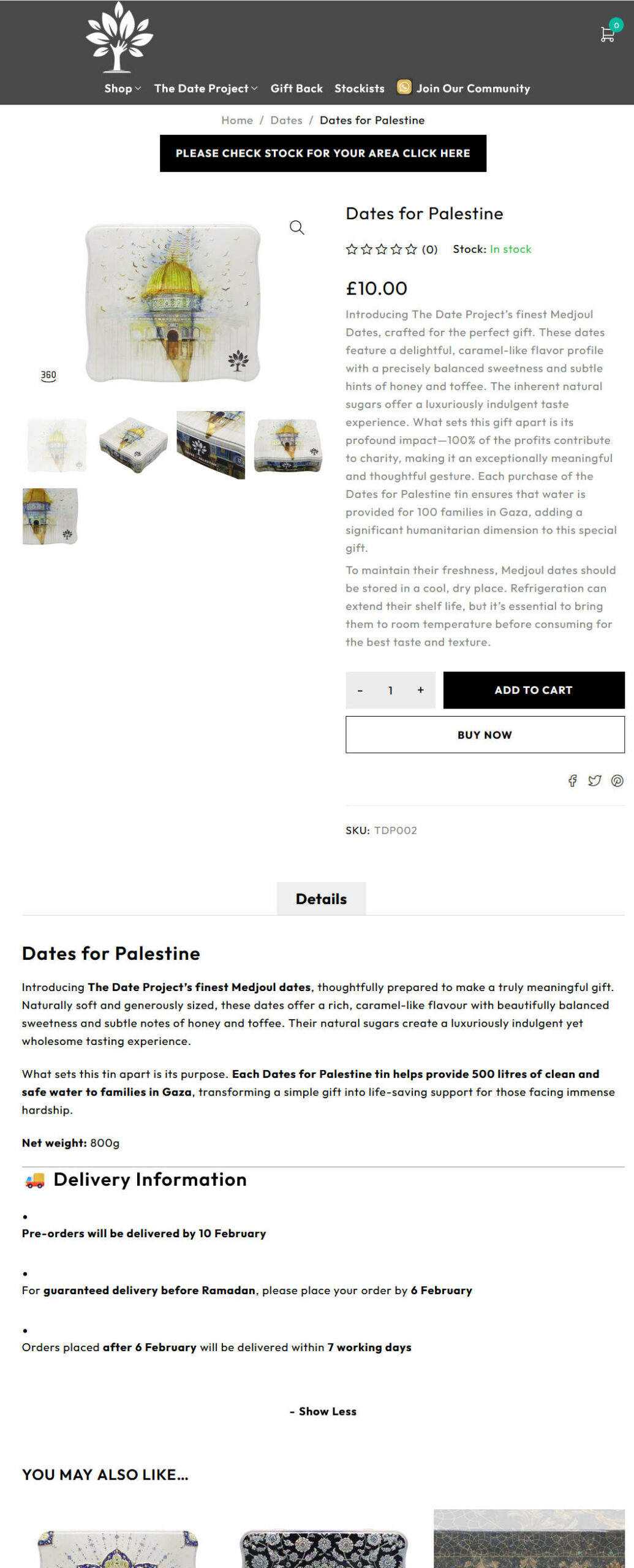
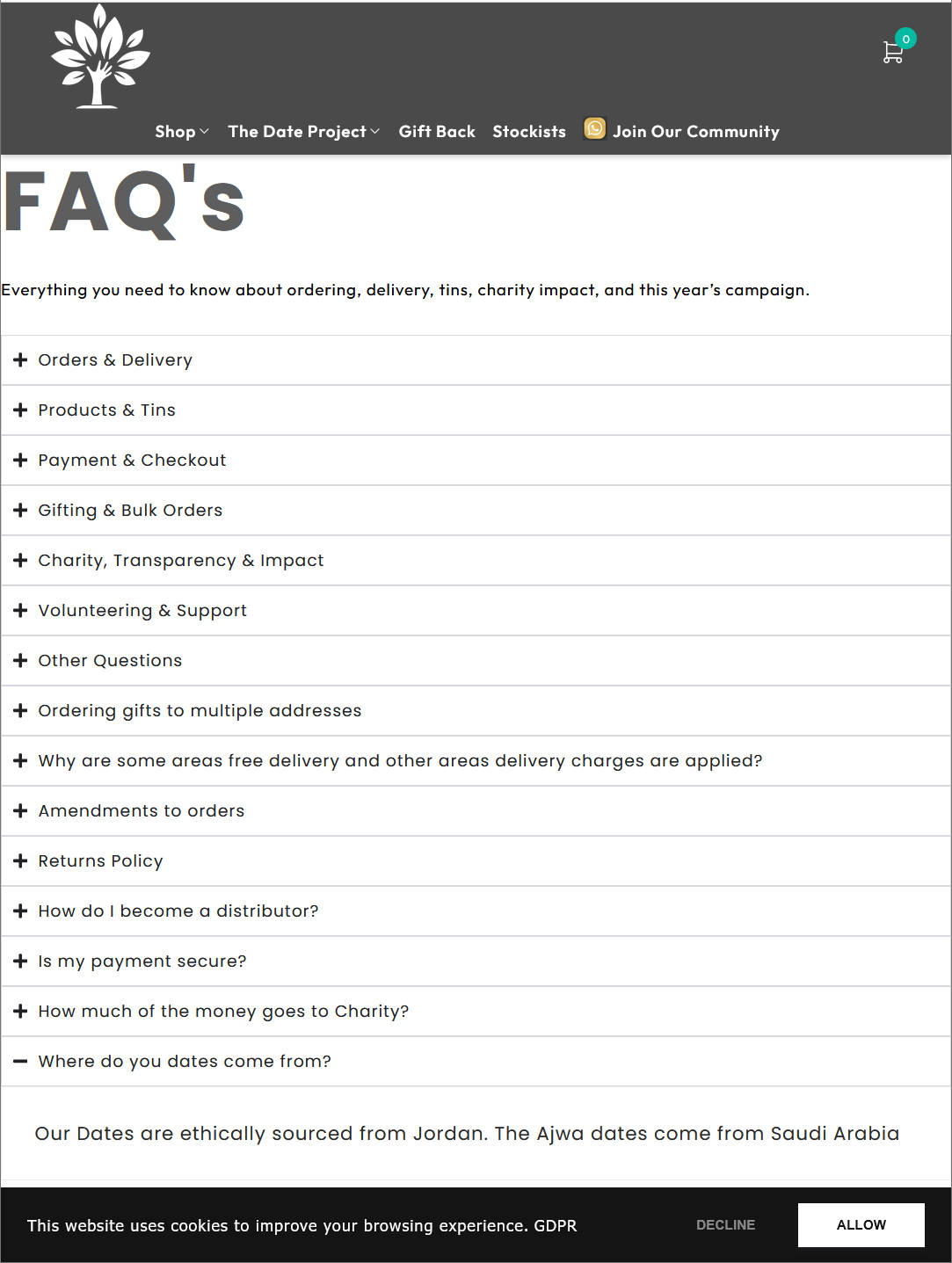
Crucially, the origin of the dates is not stated on the main product page where orders are placed. Only when navigating to the last question on the FAQ section does it become apparent that the dates are not Palestinian at all, but sourced from Jordan:
“Ours dates are ethically sourced from Jordan”.
The marketing then goes further by directly engaging with consumer concerns around mislabelled dates – particularly the well-documented issue of Israeli settlement dates being falsely labelled as Palestinian. Rather than using this concern to guide consumers toward genuinely Palestinian produce, it redirects them toward Jordanian dates as a “safe” option.
The company states:
“None of the dates come from farms within Occupied Palestine or Israel. The Jordan Valley is a very large area, comprising both Israeli or Palestinian occupied land as well as parts of Jordan. All the dates are grown on date farms situated within the Jordanian section of the Jordan Valley. As a result customers need have no worries as to where the dates come from, or whom they are supporting.”
This framing is significant. It leverages real consumer confusion – caused in part by Israeli settlement dates being mislabelled as Palestinian – to position Jordanian dates as the ethical alternative. In doing so, it benefits from the demand for Palestinian products while diverting that demand away from actual Palestinian farmers.
While the charitable component is meaningful, the overall presentation risks misleading consumers by:
- Encouraging the assumption that the product is Palestinian.
- Blurring the critical distinction between supporting Palestine and sourcing from Jordan.
- Using concern about falsely labelled settlement dates to promote Jordanian sourcing instead.
- Failing to clearly foreground the true origin of the dates at the point of purchase.
This results in a model where the imagery, language, and cause are Palestine-focused, but the underlying product is not – allowing Jordanian dates to be sold on the back of consumer solidarity with Palestine.
Rift Valley Farms
Rift Valley Farms is one of the few brands that the Palestinian Dates Monitoring Authority this year has verified as authentic Palestinian dates. Its organic range grown on its own farms near Jericho, in particular has high traceability standards. This has made it a trusted option for consumers specifically seeking dates from Palestine.
However, the introduction of a new product – “Jordanian Premium Organic Medjoul Dates” – alongside its Palestinian range creates a direct point of comparison that risks blurring this clarity.
As with other brands, the distinction between origin and association becomes critical. Dates marketed with references to Palestine are not necessarily dates from Palestine.
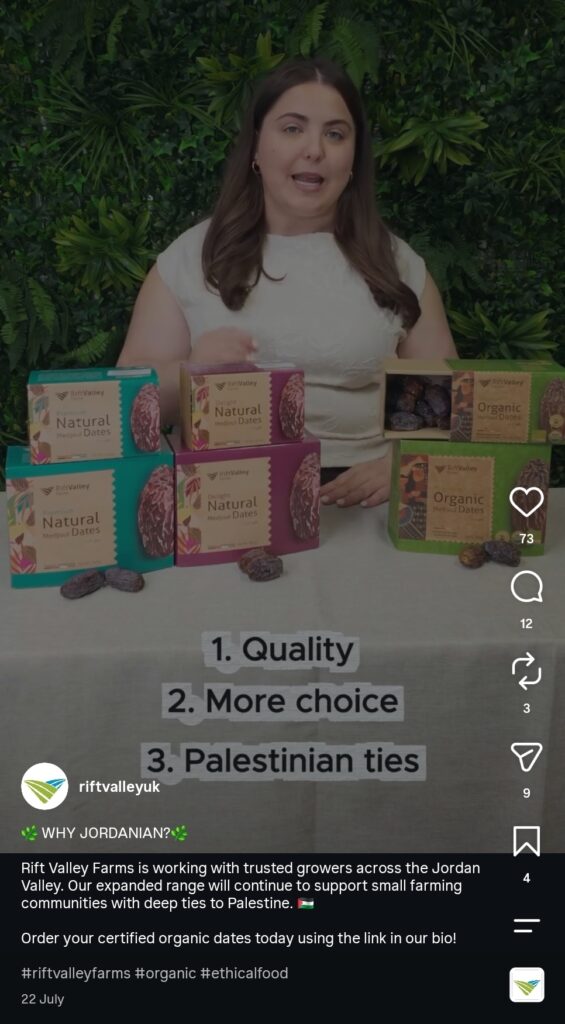
Rift Valley Farms says of it’s new Jordanian dates product:
“Most importantly it supports small farming communities with deep cultural ties to Palestine”.
This framing shifts the emphasis away from where the dates are actually grown. “Supporting communities with ties to Palestine” is not the same as sourcing directly from Palestinian farmers living and working under occupation.
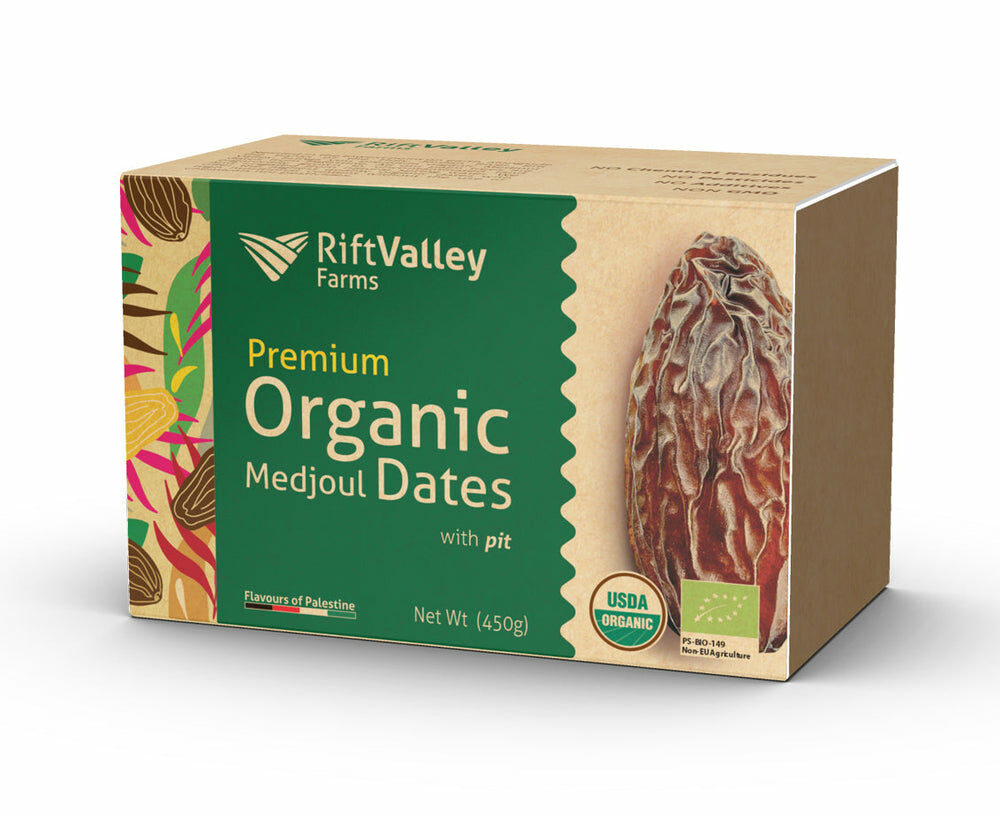
The product labeling reinforces this ambiguity:
- Palestinian dates: “Premium Organic Medjoul Dates” with “Flavours of Palestine”.
- Jordanian dates: “Premium Organic Medjoul Dates” with “Palestinian Rooted – Jordanian Grown”.
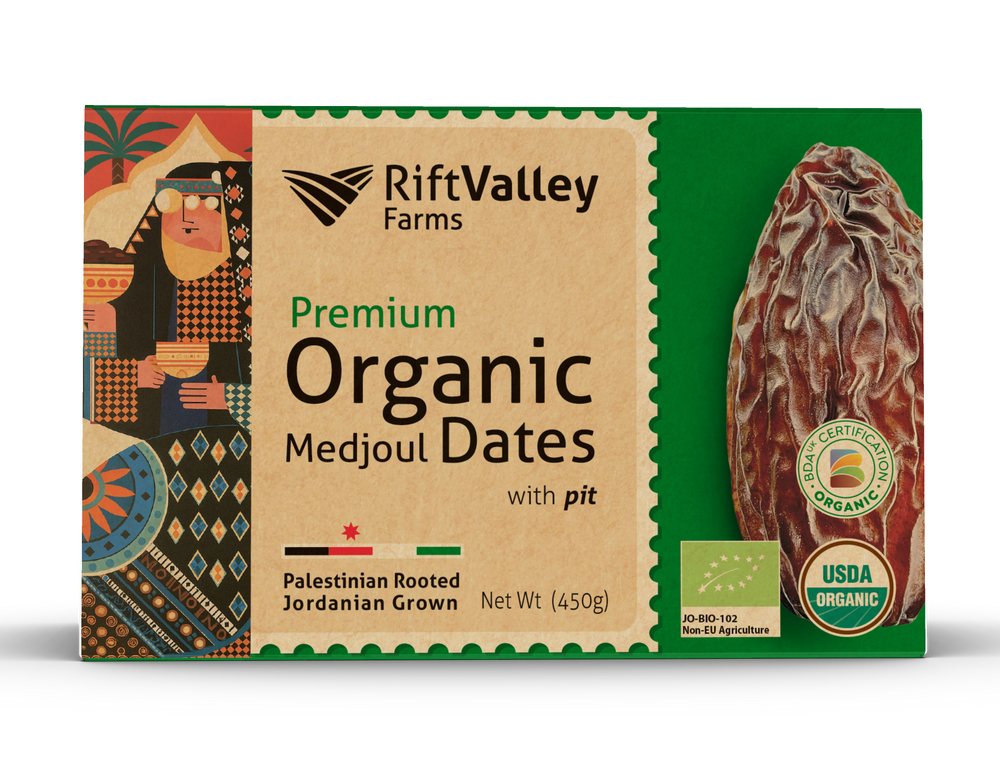
While technically accurate, “Palestinian Rooted – Jordanian Grown” risks softening a crucial distinction. For consumers trying to ensure they are buying Palestinian produce, the difference between “rooted in” and “grown in” Palestine is significant.
As with “Dates for Palestine” versus “Dates from Palestine”, the issue here is not just wording – it is how that wording interacts with consumer expectations. Many buyers actively seek Palestinian dates to materially support Palestinian farmers, not simply products that reference Palestinian heritage or identity.
By introducing Palestine-linked language into the marketing of Jordanian dates, there is a risk of:
- Blurring the line between Palestinian and non-Palestinian products.
- Diverting demand away from verified Palestinian producers.
- Capitalising on consumer solidarity with Palestine without maintaining full clarity on origin.
Given Rift Valley’s existing credibility in Palestinian sourcing, this shift is particularly significant. It places greater responsibility on the brand to ensure that distinctions between products are not only technically accurate, but immediately clear and unambiguous to consumers at the point of purchase.
Overall Assessment
Jordanian Medjoul dates are often presented as an ethical alternative to Israeli dates. However, this claim becomes difficult to sustain when considering:
- The reliance on stolen Palestinian water to sustain agriculture.
- The dependence on stolen Palestinian natural gas for energy.
- The integration of Israeli-linked industries into Jordan’s export economy.
- The demonstrated political and military alignment with Israel.
- The risk of indirect trade flows that may obscure product origin.
- The use of Palestine in marketing despite the absence of Palestinian production.
For consumers seeking to materially support Palestinian farmers and avoid complicity in these systems, verified Palestinian dates with clear traceability remain the most direct and transparent option.
Greater honesty in labeling and marketing is essential so that consumers can make informed choices without confusion or misrepresentation.
Response From Rift Valley Farms
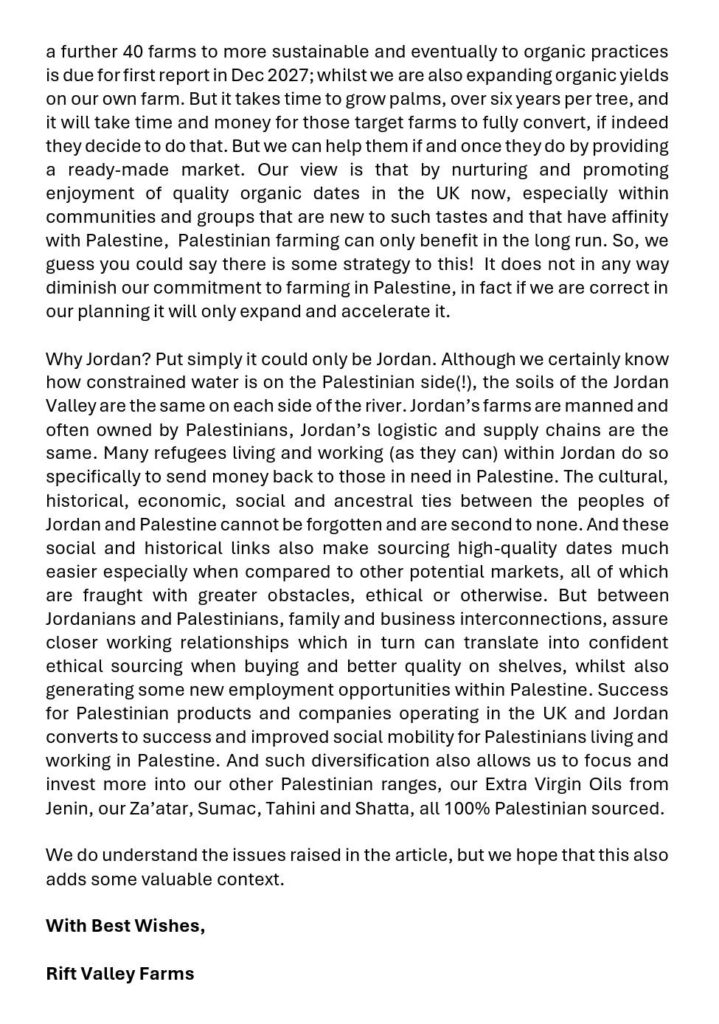
We shared the article with Rift Valley Farms ahead of publication. In response, the company provided additional context for its controversial decision to introduce Jordanian Medjoul dates to its range.
Rift Valley Farms says the move is temporary and applies only to its organic Medjoul dates. More than 85% of its wider date range consists of non-organic dates sourced entirely from Palestine.
The company says there are only four organically certified date farms in Palestine, including its own, and that it purchases 90% of their yield for export. However, it says UK demand for organic Medjoul dates “far outstrips supply”.
“We have therefore chosen to buy from some selected non-Palestinian farms in order to meet this demand in the short term,” the company said, “whilst in the long-term investing into the growth of new Palestinian organic date production.”