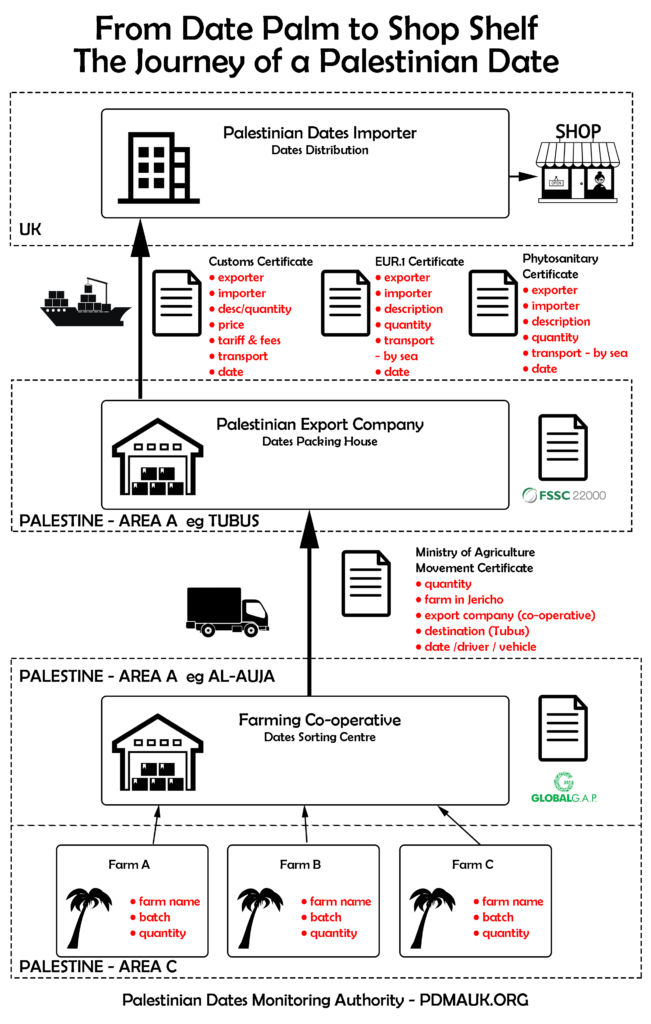
This article follows the journey of a Palestinian date from its harvest to its sale in the United Kingdom. It focuses on the documents that trace this process and verify the fruit’s authentic Palestinian origin. It also outlines some of the current limitations and challenges involved.
Farming Under Military Rule
When Israel invaded the West Bank in 1967, it divided Palestinian population centres into 165 small enclaves in order to separate them from their farmland and annex the land for colonisation – for settlement building. This arrangement was formalized under the Oslo Accords, which defined Areas A and B for partial Palestinian administration while leaving Area C – over 60% of the West Bank – under full Israeli military control. Although Oslo required a gradual transfer of Area C to Palestinian authority, that transfer never occurred.
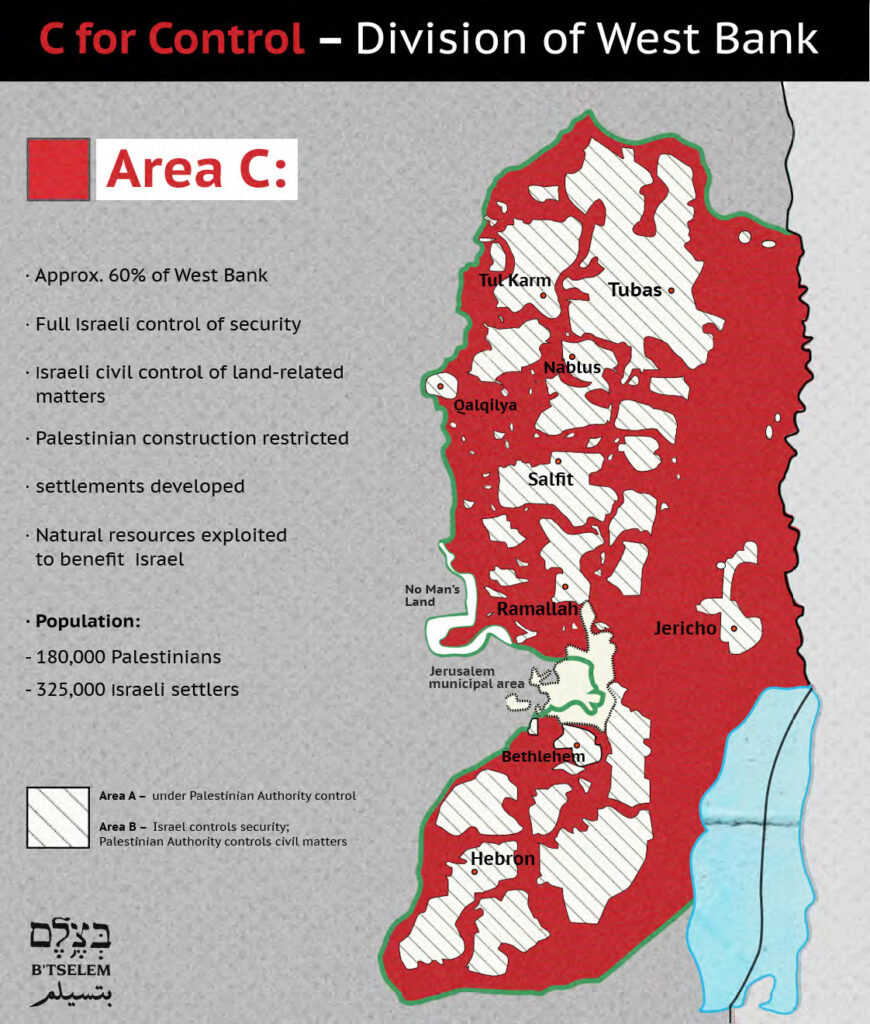
Today, more than 400,000 Israeli settlers live in some 230 illegal settlements in Area C, alongside around 300,000 remaining Palestinians who are resisting ethnic cleansing – under constant pressure to leave. Most Palestinian date farms are located in this area. Farmers there face continual harassment from both the Israeli military and nearby settlers, who restrict their access to land and water, and routinely terrorise them.
Farming remains a vital part of the Palestinian economy and a symbol of resistance. By continuing to cultivate their land, Palestinian farmers are standing against displacement and colonial expansion.

Water
Palestinian farmers face severe restrictions on water access. The Jordan River and natural springs are off-limits to them, while Israeli settlers in illegal settlements enjoy continuous water pumped into their homes, even for private pools, which passes through Palestinian communities denied the same basic resource.
Palestinians are forbidden from digging wells to irrigate their crops. If they attempt to do so, the Israeli military may destroy the wells and penalize them. Even rainwater collection pools are demolished under accusations that Palestinians are “stealing” Israeli rainwater.

According to the human rights group Al Haq, Israeli settlers use up to 18 times more water for agriculture than Palestinian farmers in the West Bank. Palestinians are forced to buy water from tankers, from Mekorot, Israel’s national water company, which steals Palestinian water from aquifers under Palestinian territory and sells it back to them at substantially extortionate prices – around 10 USD per cubic metre in 2017, according to Amnesty International.
Harvest
A joint report issued in 2025 by the Palestinian Ministry of Agriculture found 893 date palm farms operating in the West Bank, most of them family-run. Many farmers work together through cooperatives to share resources and increase their bargaining power during sales.
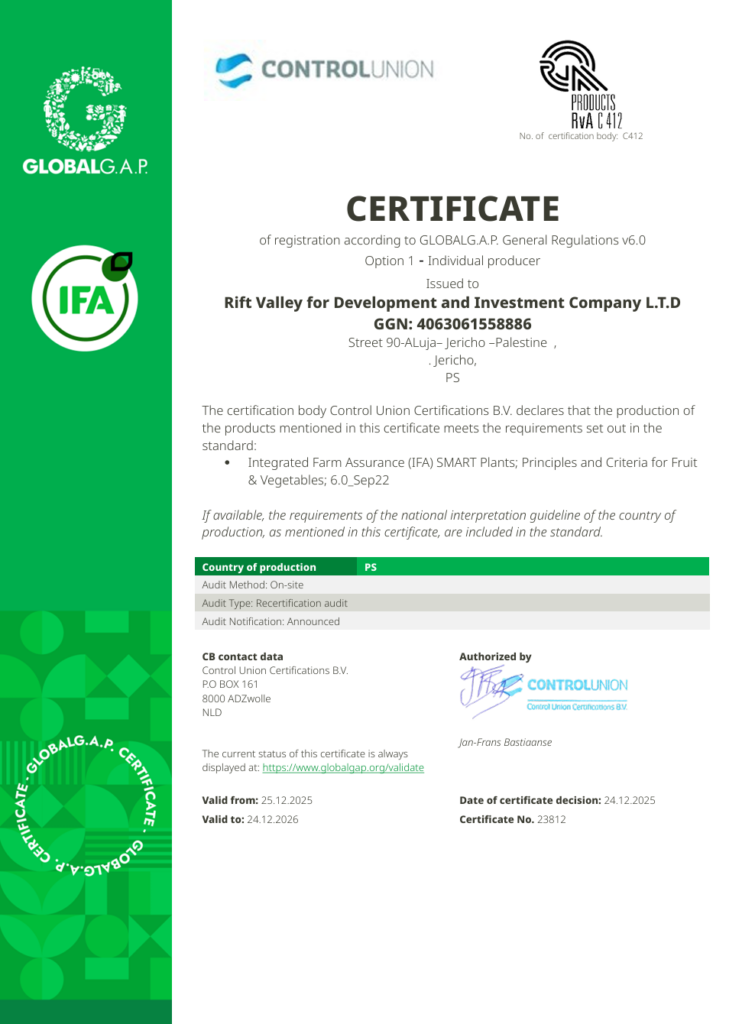
Large farms and cooperatives that hold GLOBALG.A.P. certification are required to maintain full traceability records linking every batch of dates to the original field, harvest date, and all handling stages. These records are essential for meeting food safety standards and are usually demanded by higher-end supermarkets and export markets.
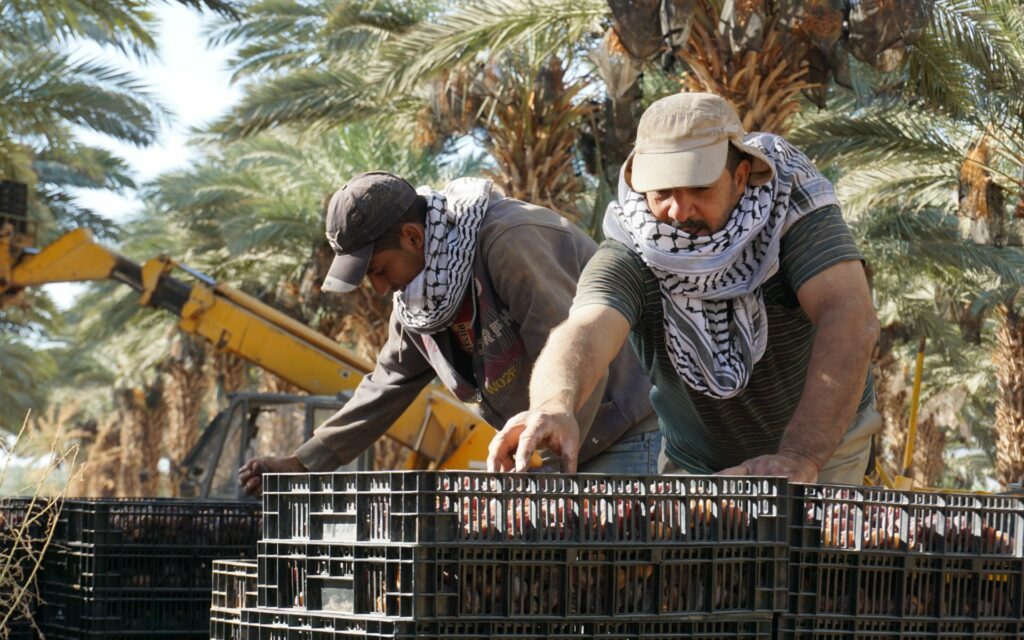
Date harvesting begins in late September and continues through October. The fruit is collected and delivered to sorting or packing centres on the same day.
Packing Houses
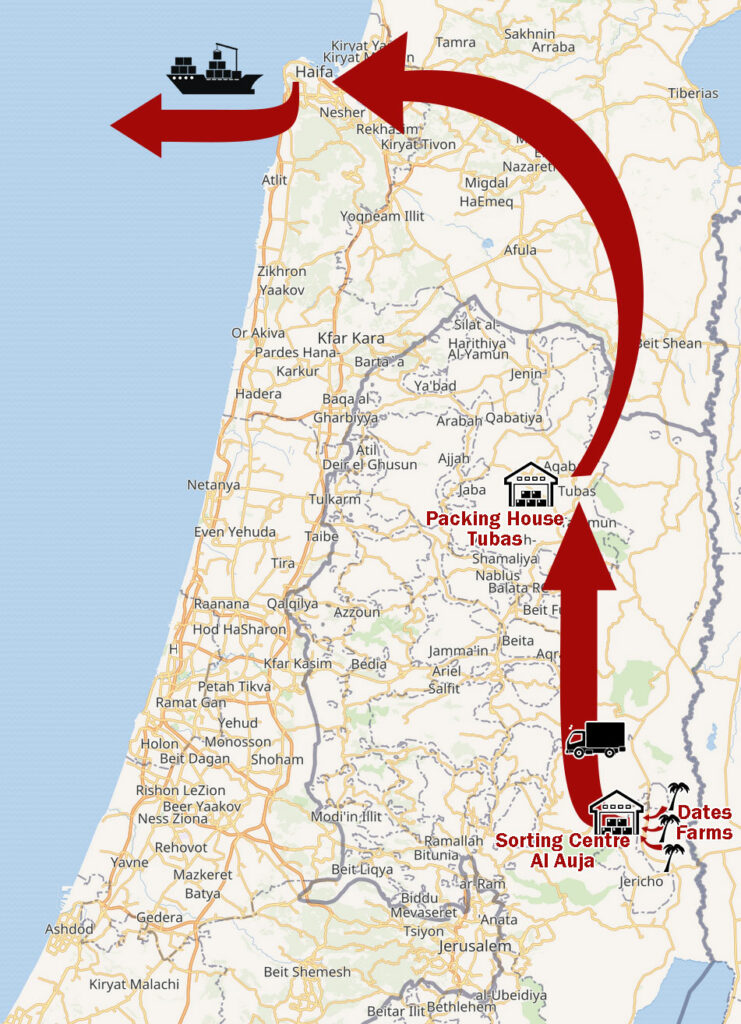
Sorting and packing centres are typically located in Area A under Palestinian Authority control, for example in Al Auja near Jericho. These facilities may be owned by cooperatives or by Palestinian agricultural companies working in partnership with farms. Registration papers can be checked to confirm Palestinian ownership.
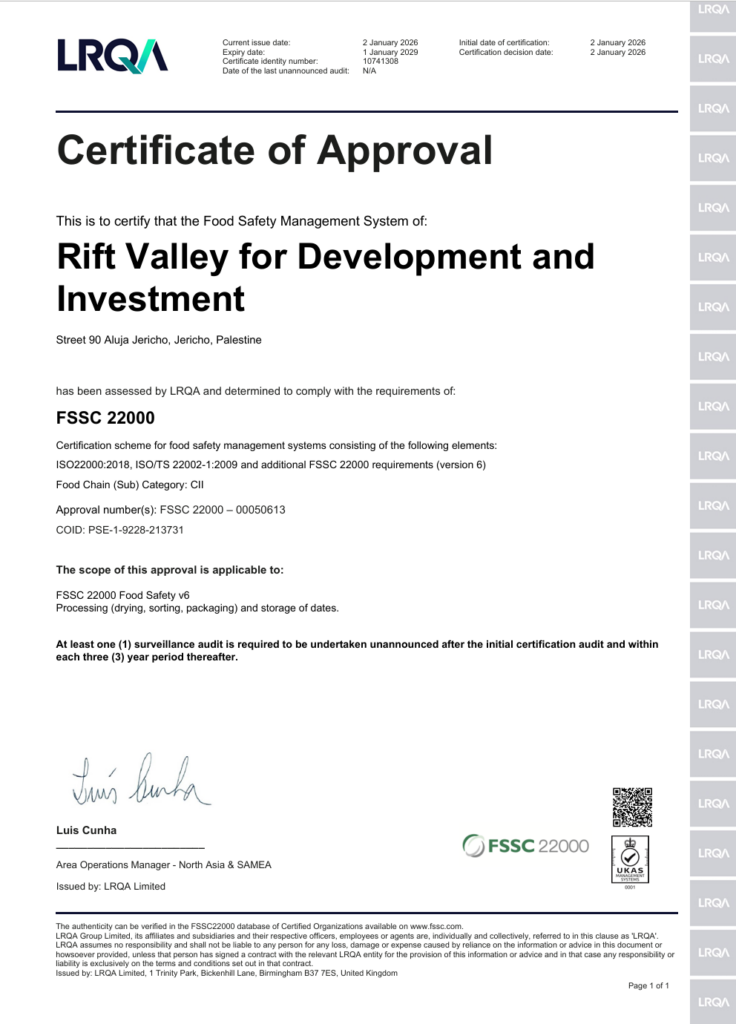
Most European supermarkets require suppliers to hold a food safety certification recognized by the Global Food Safety Initiative (GFSI), such as FSSC 22000. Certified facilities must ensure full traceability “one step back and one step forward” to allow swift recalls or investigations if needed. To meet these standards, most packing houses use modern Enterprise Resource Planning (ERP) systems that track every step from farm to fork.
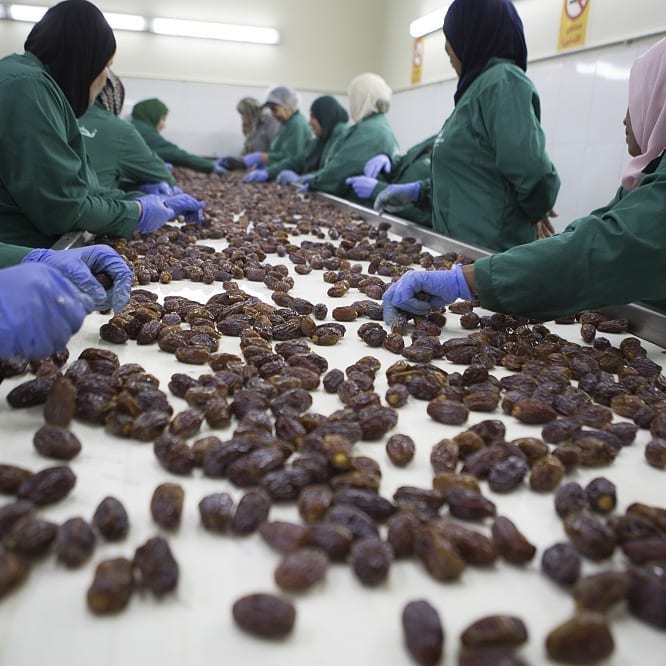
At the sorting centre, dates are cleaned, graded by size and quality, and stored at around -18 °C to preserve quality. Whilst most centres provide packing facilities, some Palestinian exporters have their own packing houses in which case the dates are transferred there.
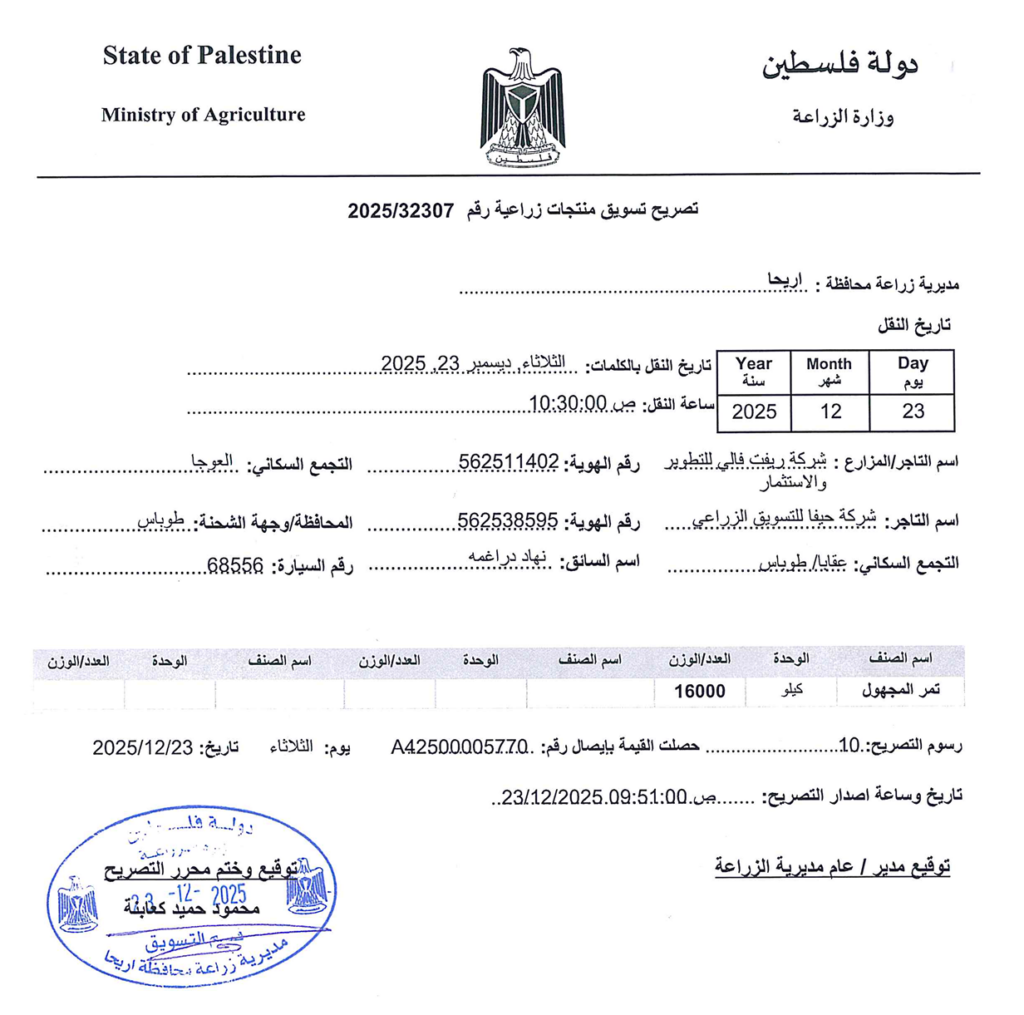
Every transfer requires an internal movement certificate from the Palestinian Ministry of Agriculture, specifying quantities, supplier and buyer details, date, and transport details down to the drivers name, vehicle number, and time of transfer.
Internal Movement Certificate
Palestinian Ministry Of Agriculture Internal Movement Certificate,
Indicates
- date and time of transfer
- trader/farmer name & location (from)
- trader name & location (to)
- vehicle number
- driver name
- permit payment fee
- quantity of dates
- permit stamped and certified by the Ministry of Agriculture
For example, this sample internal movement certificate provided by Yaffa records the transfer of 16,000 kgs of Medjool dates from a sorting centre in Al Auja to a packing house in Tubas.
At the packing house, dates are packed into branded cartons for UK importers, then palletised and loaded into refrigerated containers for export. One container typically carries around 20 pallets, or roughly 20 tonnes of dates.
Military Checkpoints
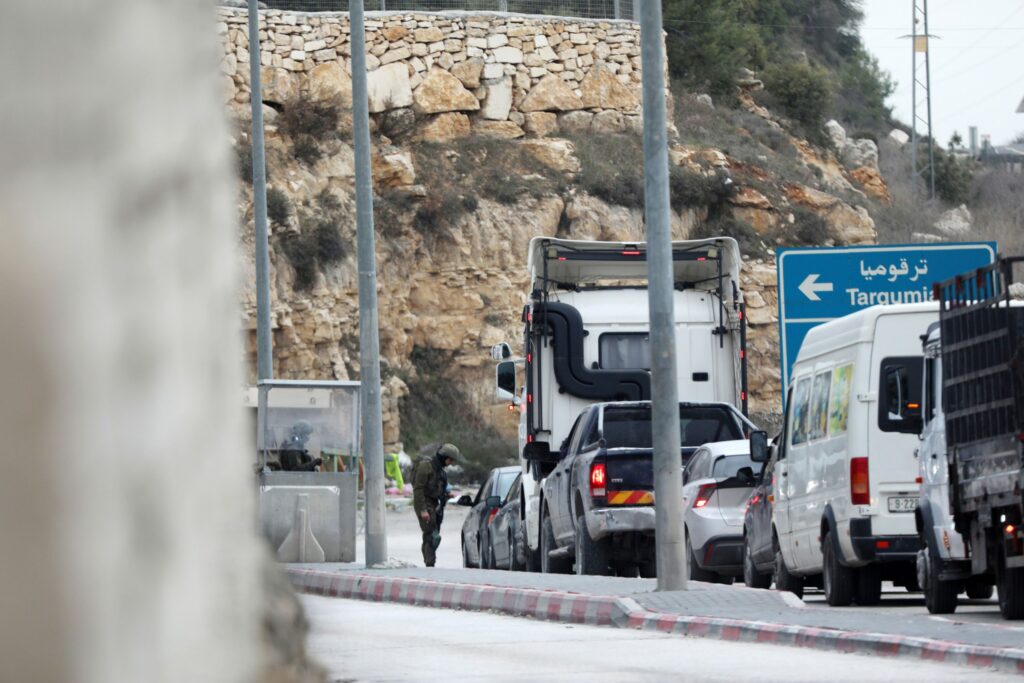
A 2026 field report found nearly 900 Israeli military checkpoints across the West Bank. Palestinian trucks carrying export goods have to navigate these Israeli checkpoints before reaching the Israeli border. With checkpoints and continual hindrances, the journey from farm to port takes two days instead of two hours. The authorities also force Palestinian farmers to transfer their dates at the border from one freezer to another – back to back transfer from Palestinian trucks to Israeli trucks. Since dates should be transported at a constant -18°C, this not only increases costs but also puts the quality of the product at risk. This in turn makes the finished product more expensive for the consumer. Illegal Israeli settlers, who do not have to confront any of these challenges, can sell their dates at cut prices. This is why one of the indicators of dates of questionable origin is the price – genuine Palestinian dates will cost more.
Export Routes
After crossing the border, containers usually depart through the Israeli ports of Haifa or Ashdod. A smaller proportion – around 3.6%, according to the Palestinian Central Bureau of Statistics in 2010 – travels through Jordan’s Port of Aqaba via the King Hussein (Allenby) Bridge. However, this route is unstable, as Israel frequently closes the bridge for long periods as collective punishment – it was closed for over 3 months last year. Even when open, Israel enforces heavy restrictions that discourage exports.
Export Documentation
To ship dates abroad, exporters must obtain a Customs and Excise certificate from the Palestinian Ministry of Finance. It includes details such as date, importer and exporter names, quantity, price, origin, destination, tariff rate, and customs fees. Each document is stamped and certified by the Ministry.
Customs and Excise Certificate
Palestinian Authority Ministry of Finance Customs & Excise certificate,
Indicates
- date
- import and export company
- origin and destination
- quantity of dates
- price of dates
- tariff rate
- customs fees
- method of shipment
- stamped and certified by the Ministry of Finance Customs and Excise
Two additional certificates are required for export:
EUR.1 Certificate
Issued by the Palestinian Authority Customs and Excise department, the EUR.1 Movement Certificate verifies the product’s Palestinian origin and ensures reduced import duties under trade agreements. It lists the exporter and importer, quantity, description, shipment method, and official certification.
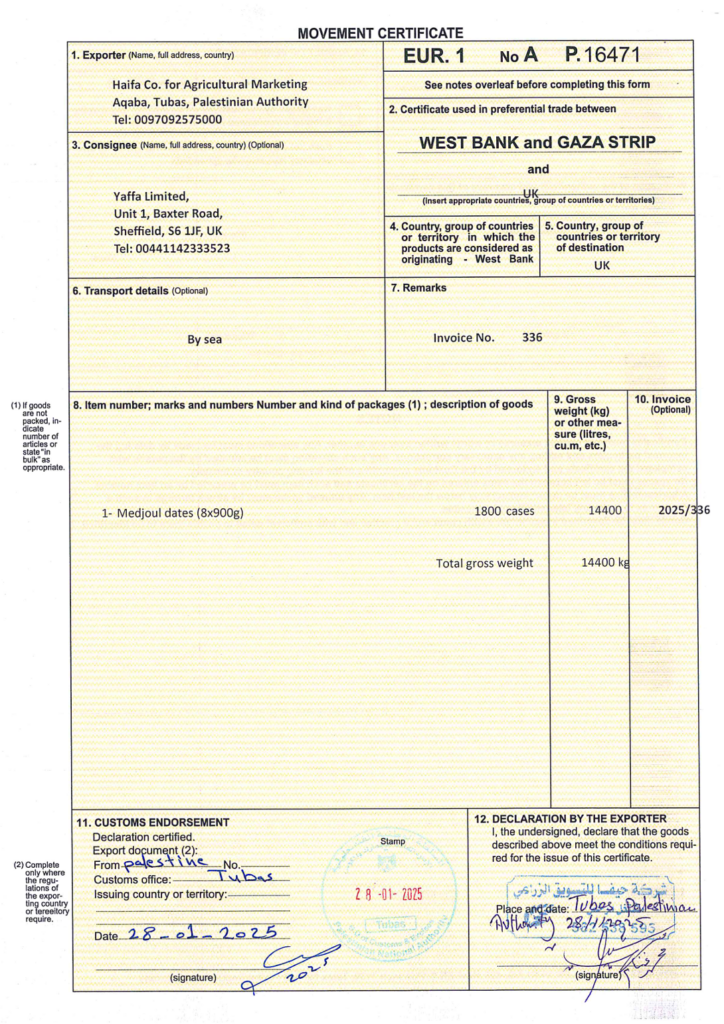
EUR.1 Certificate
Palestinian Authority Customs & Excise EUR.1 movement certificate,
Indicates
- date
- import and export company
- origin and destination
- quantity of dates
- method of shipment
- stamped and certified by Customs and Excise
Phytosanitary Certificate
This official plant health document, produced by the Ministry of Agriculture, confirms that the shipment is of Palestinian origin and free of pests and diseases and complies with the import country’s regulations. It includes inspection results, treatment information, and verified shipment details including buyer and seller information.
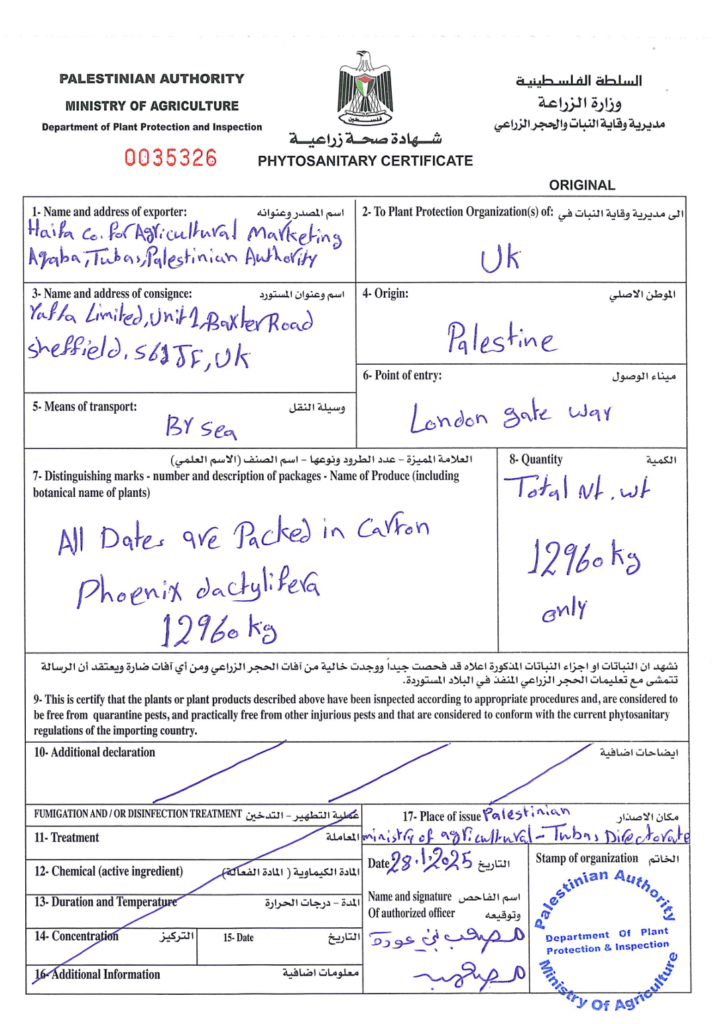
Phytosanitary Certificate
Palestinian Authority Ministry of Agriculture Phytosanitary certificate,
Indicates
- date
- import and export company
- origin and destination
- quantity of dates
- method of shipment
- place of issue
- treatment
- stamped and certified by Palestinian Authority Ministry Of Agriculture
Every Palestinian date shipment carries these three certificates, along with a packing list and sales receipts confirming provenance.
Once in the UK, containers are delivered to importers’ distribution centres and then forwarded to wholesalers, retailers, and finally consumers.
Systematic Mislabeling of Settlement Dates and UK Enforcement Failure
The UK-Israel Trade and Partnership Agreement categorically excludes goods produced in Israeli settlements in the territories occupied since June 1967 from preferential tariffs, and UK rules require precise origin information so that these products cannot be disguised as Israeli goods. In practice, dates, under commodity code HS0804100091, grown in illegal settlements attract a 6% duty, while dates from Israel or Palestine benefit from a preferential duty rate of 0%.
The UK government explicitly endorses clear labelling of settlement goods “so as not to mislead the consumer.”
Yet revelations in an Israeli agricultural trade publication indicate that the overwhelming majority, up to 75%, of Israeli dates are actually grown in illegal settlements in the occupied West Bank. Despite this, Israeli dates sold in the UK, including those sold by major supermarkets, carry no indication that they originate in Israeli settlements and are systematically mislabelled as produce of Israel.
The largest Israeli date exporters, Hadiklaim and Mehadrin, have been exposed repeatedly for fraudulently labelling settlement dates as Palestinian dates, both to evade the higher tariffs that apply to settlement produce and to bypass consumer boycotts of Israeli goods.
Where there is any doubt about the declared origin of goods, HMRC has a clear obligation to investigate and verify that settlement products do not unlawfully benefit from Israel’s trade preferences.
The UK authorities have failed to discharge this duty, effectively turning a blind eye while settlement dates are routinely passed off as Palestinian produce and allowed to be sold in the UK under false pretences.
Because of this systemic failure, responsibility for verifying the authenticity of Palestinian dates has fallen to the Palestinian Dates Monitoring Authority.
This Year’s Verification Process
In this first year, the Palestinian Date Monitoring Authority (PDMA) reached out to all major UK suppliers of Palestinian dates, a total of fourteen companies. Each was asked to submit two full seasons of EUR.1 and Phytosanitary certificates, as well as any internal movement records, to verify consistent sourcing. A month was given for the submission of documents. The companies were also asked to pledge that they neither buy nor sell any Israeli goods – all goods, not just dates. This commitment was to ensure that all their business practices remain free from complicity with apartheid. Only four companies successfully completed verification: Yaffa, Zaytoun, Rift Valley, and Sofra.
Future Improvements
There is significant potential for deeper transparency and stronger traceability within the Palestinian date industry. Some companies, such as Yaffa, have already set higher standards by going beyond the required verification documents. In addition to providing EUR.1 and Phytosanitary certificates, Yaffa shared sales receipts, Customs & Excise certificates, and internal documentation from its Enterprise Resource Planning (ERP) system. Because Yaffa have teams on the ground in Palestine, every batch of dates entering its facility can be traced to specific farms, harvest dates, and quantities. The company has shared sample records to demonstrate this full chain of traceability.
For Palestinian date suppliers based abroad without a presence in Palestine, maintaining the same level of direct oversight is more difficult. They depend heavily on their local partners for documentation, so the accuracy of traceability records rests on mutual trust and the integrity of Palestinian institutions.
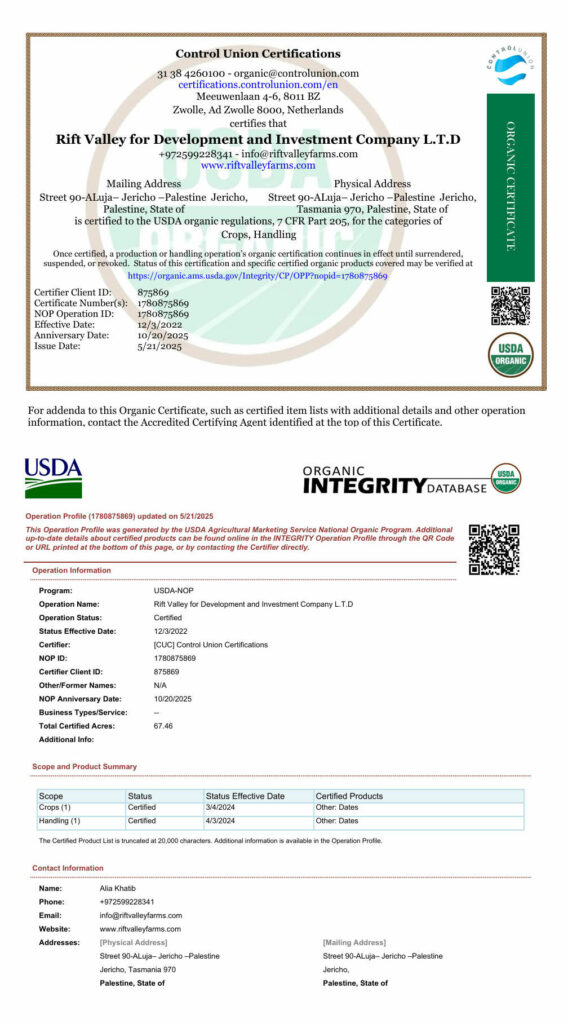
Rift Valley Farms provides a strong example of advanced traceability. It runs the largest organic date farm in Palestine, where organic certification requires a stricter and more comprehensive system than GLOBALG.A.P. standards. Upholding “organic integrity” demands that certifiers can reconstruct the complete journey of every retail pack – from certified organic farm to final buyer – and confirm that no mixing with non‑organic produce occurred.
Another noteworthy example is Zaytoun, founded as a non‑profit social enterprise dedicated to supporting marginalized Palestinian farming communities. Its mission extends beyond trade, working to ensure that economic solidarity and ethical sourcing empower the farmers themselves. However, in the current verification framework, such social initiatives are not yet explicitly rewarded.
As the process evolves, the PDMA intends to develop more comprehensive criteria that recognise these wider forms of accountability. Future assessments will focus not only on documentation but also on a company’s social commitments, transparency practices, and direct engagement with Palestinian farmers. The goal is a verification system that captures the full ethical and economic reality of the industry, rather than one based solely on paperwork.
Limitations
In the interests of transparency, it is important to acknowledge the limitations of our verification process, particularly concerning date mixing.
In the UK, a key issue arises from companies misrepresenting the origin of dates. Offa Exotics, for example, operates in the UK but is not listed at Companies House. The company openly sources dates from Mehadrin, which describes itself as Israel’s largest grower of dates, and then markets products as “produce of Palestine,” using packaging decorated with mosques and Arabic text.
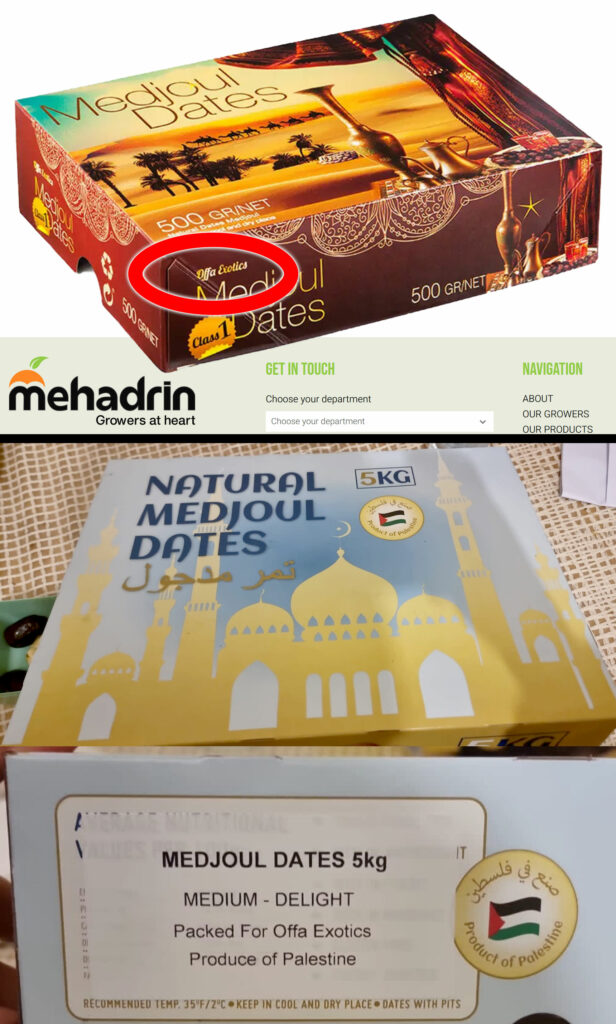
This kind of mislabelling undermines legitimate Palestinian producers. Our verification process relies heavily on the cooperation of suppliers to provide full and accurate documentation. Much of the process, therefore, depends on trust. We cannot independently confirm whether all requested certificates proving Palestinian origin – covering two full seasons – have been supplied, or whether non-Palestinian dates have been mixed in and sold as Palestinian under the cover of these certificates.
Mixing of Dates in Palestine
There is also a separate and complex issue involving the mixing of dates within Palestine itself. Most Palestinian date farms are located in Area C, which lies under Israeli military control and outside the direct oversight of the Palestinian Authority. With illegal Israeli settlement plantations operating side by side, opportunities for corruption and cross-contamination are significant.
Recent Israeli reports indicate that Israel’s agricultural export sector is in deep crisis. Farmers warn of a looming collapse as global isolation intensifies. The Red Sea blockade has cut off access to Asian markets, and European markets have contracted amid boycotts responding to Israel’s genocide in Gaza. Meanwhile, figures published in Israel’s Lahaklai agricultural journal suggest that up to 75% of Israeli dates come from illegal settlements, far higher than previously estimated. This creates a strong incentive for settlers to pass off their produce as Palestinian.
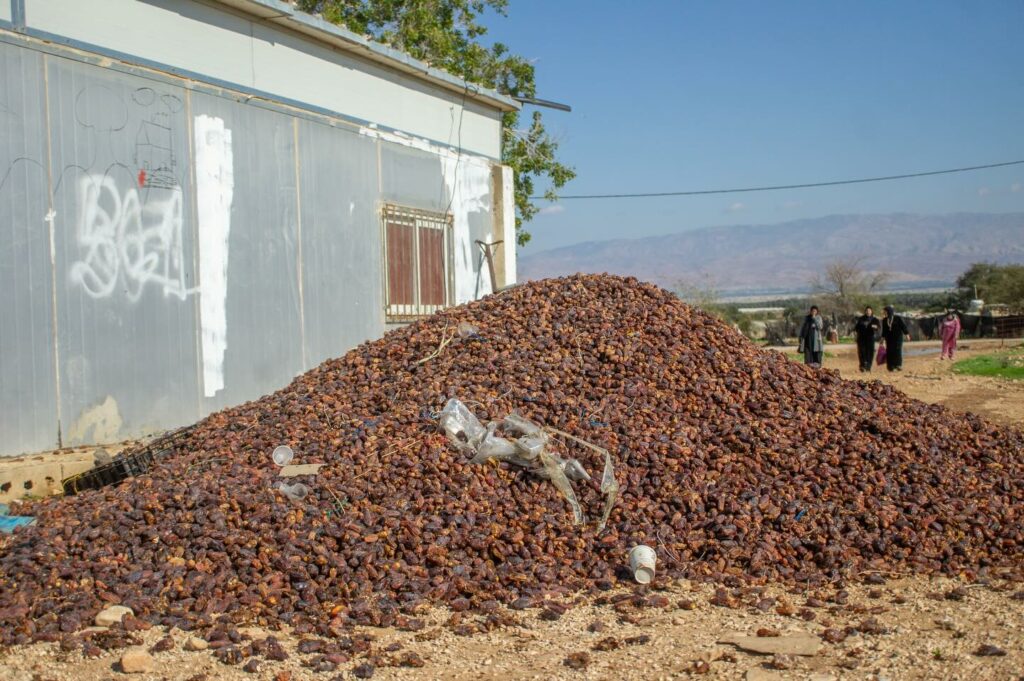
Cases have emerged where trucks from Palestinian farms in Area C reportedly take on additional loads of Israeli settlement dates before reaching the packing houses, effectively blending the produce. The Palestinian Ministry of Agriculture’s licensing system may unintentionally allow this practice. Instead of licensing based on verified farm output, licences are based on inflated estimates. For example, the head of the Palestinian Palm Council revealed that one of his dates farms received a licence for 100 tons, but when the fruit was picked, it turned out that the production did not exceed 68 tons. This would leave room for an unscrupulous operator to purchase 32 tons of cheap settlement dates and pass them off as Palestinian with a licence from the Ministry backing it.
Date Laundering Scandal
Between 2019 and 2021, the Palestinian anti-corruption watchdog Aman Coalition for Integrity and Accountability exposed a major “date laundering” scandal. Two Palestinian Authority ministries, six major date producers – including one owned by a former minister – and nine packing houses were found to be involved. Together, they controlled around 60% of the Palestinian date market and had been exporting Israeli settlement dates as Palestinian, even using falsified EUR.1 certificates of origin to wrongly use up tariff-free export quotas reserved for genuine Palestinian dates.
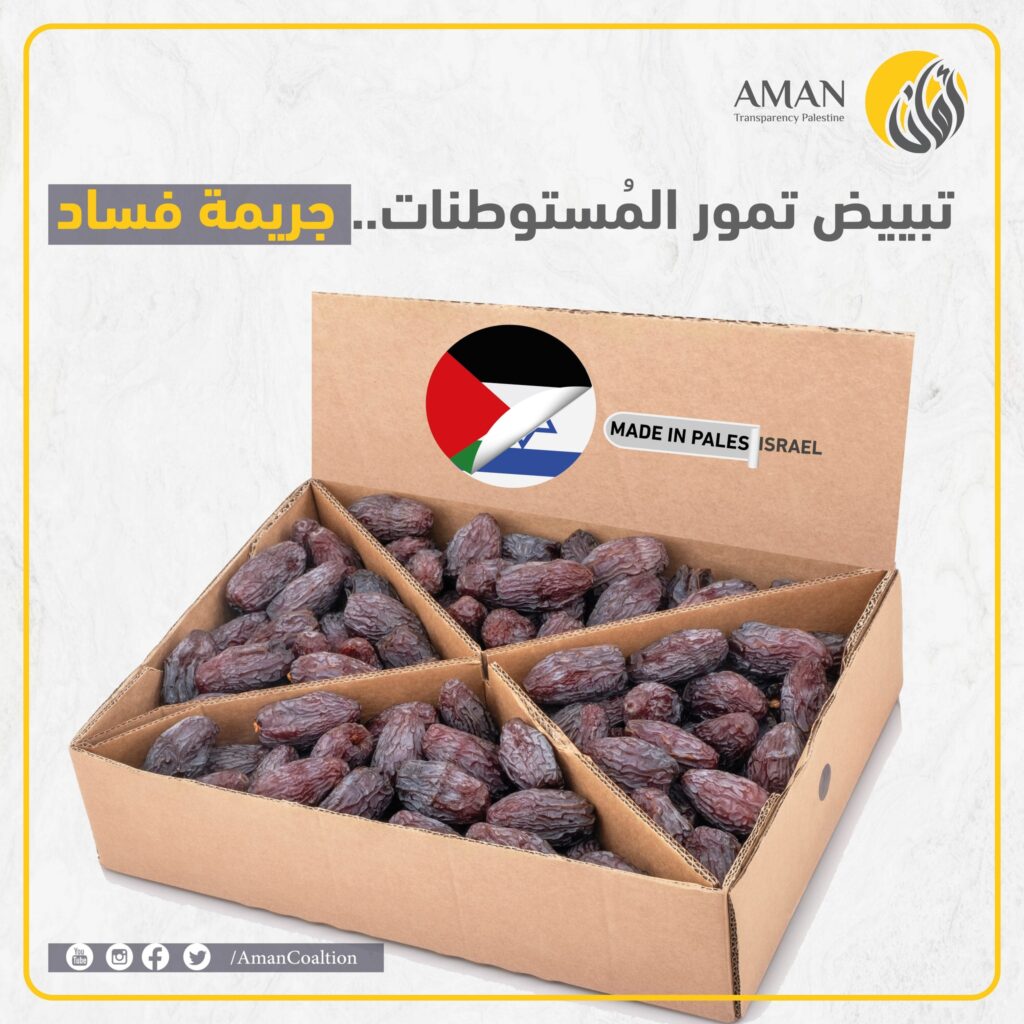
Our verification process ultimately depends on the integrity of Palestinian institutions and the authenticity of the certificates they issue. Although corruption on this scale is alarming, we must take care not to overstate these problems as that would serve Israeli interests.
Palestinian farming communities stand on the front line, resisting against the ethnic cleansing of Palestine. They rely on the export of their harvests for survival. This issue must be tackled directly, but with balance and care.
To place the matter in context, the total value of all Palestinian imports to the UK in 2025 was £22 million, while imports of Israeli dates alone reached £24.7 million in 2024. The main focus, therefore, must remain on monitoring Israeli date imports, while continuing to strengthen transparency and accountability within Palestinian supply chains.